
This YouTuber's homebrew VR headset using mini CRTs is way cooler and more usable than you would ever imagine
Here's a challenge. Get rid of the screen door effect from VR headsets without resorting to uber high-res display panels. Solution? Use CRTs. Yes, really. At least, that's one of the main benefits an enterprising YouTuber, dooglehead, discovered when he cooked up a homebrew VR headset using actual CRTs.
Now, at this stage you're probably imagining something utterly comical, perhaps a couple of small TVs somehow attached precariously to someone's head. And as dooglehead himself says, back in the 1980s, there were indeed VR headsets made from TV-style CRTs and suspended from the ceiling on cables.
He says he would have liked to take that hardware for a spin, but it all ran off custom workstations. So even if he could find the "headsets", driving them with modern games would be basically impossible. So, yup, you guessed it, he's going to have to build something himself.
At this point, I was thinking Sony Watchman. If you've seen Oliver Stone's Wall Street or you're simply old enough, you'll know what a Watchman is. Actually, you may have seen similar tech in intercom systems.
With these kinds of CRTs, instead of firing an electron gun directly at the rear of a phosphor screen and viewing it from the front, the screen is placed at a very shallow angle to the gun and you view the phosphor screen directly, effectively at a perpendicular angle to the gun. That allows the whole construction to be relatively slim. Perfect for a "pocket TV" in the 1980s.
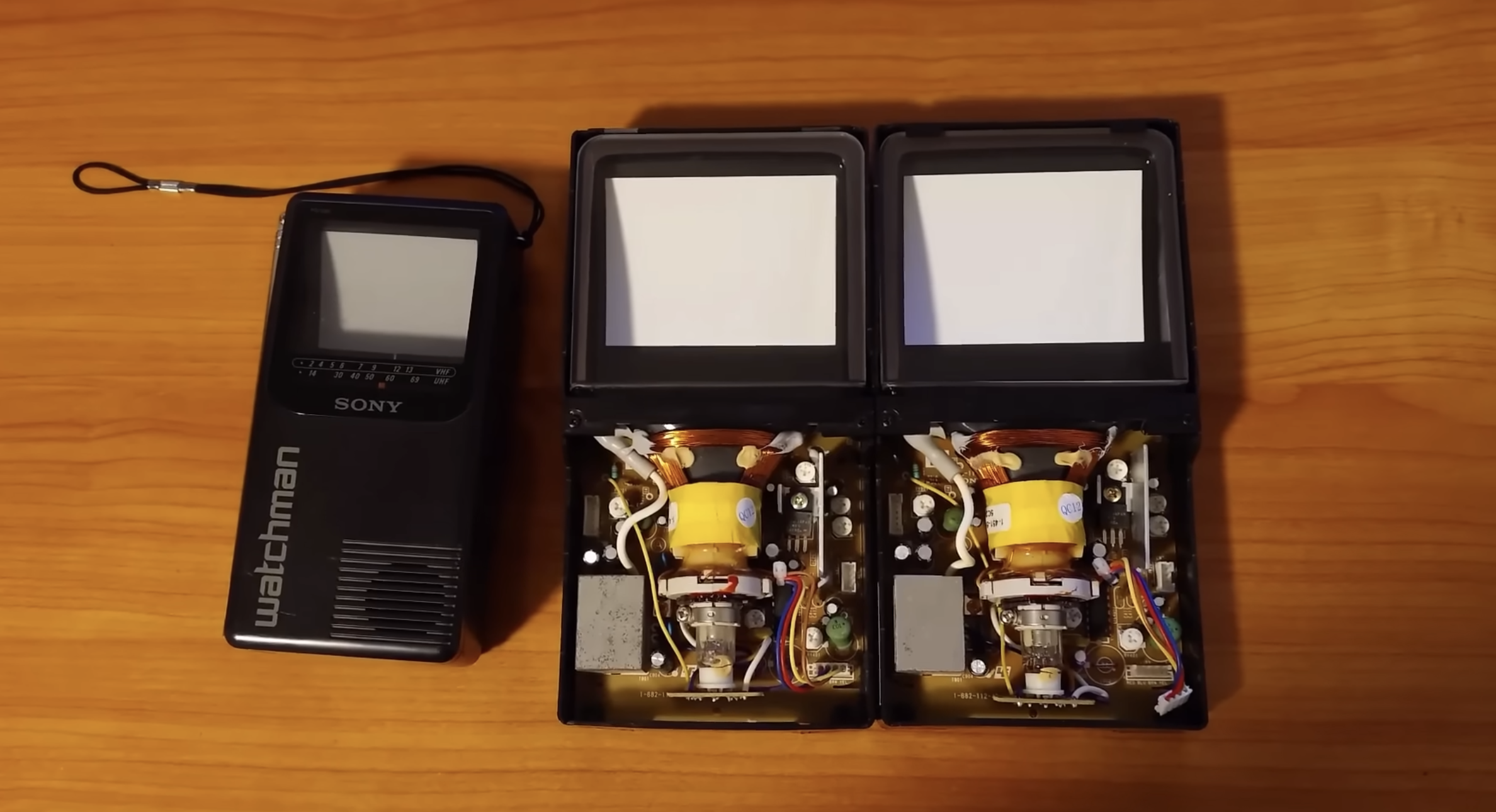
It turns out this type of CRT is still being made, but their 4-inch screen sizes are a little too big to be ideal for this application. So, sure enough, dooglehead bagged a couple of 1990s spec Sony Watchman units with 2.7-inch CRTs.
Each CRT is 640 by 480 resolution, interlaced, and black and white rather than colour. As a stepping off point, dooglehead used an open source VR headset project from Github. These are usually based on small LCDs that can be directly connected to a PC.
So, he had to use an FPGA to convert the digital video output to analogue for the CRTs. Next up was an essentially off-the-shelf infrared laser lighthouse head-tracking system.
Dooglehead then designed a custom PCB integrating the FPGA, head-tracking input, power supply for the CRT (which is just one USB output, such is the low draw of the CRTs), and then the HDMI input.
The whole shebang is housed in a makeshift cardboard chassis. Remarkably, it weighs just 544 g, similar to existing commercial VR headsets. But what is the actual gaming experience like with this contraption?
Dooglehead tried a wide variety of titles, from driving sims to first person shooters and puzzle games. One immediate impression is that the image quality is more blurry than expected, even for CRT tech.
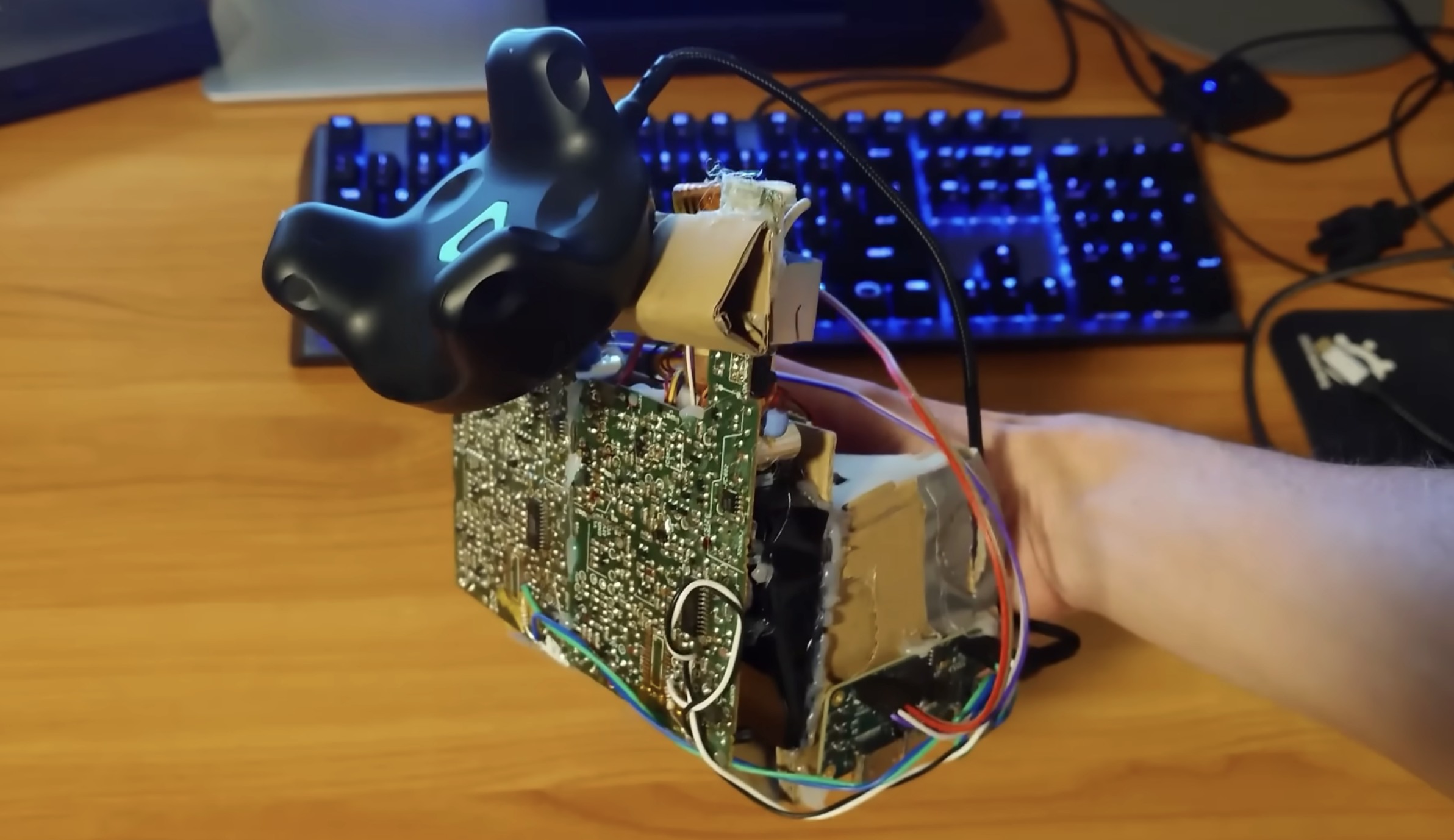
The extreme angle at which the electron gun is firing at the phosphor screen is probably partly to blame for that, he says, along with limitations of the CRT's focusing hardware. On the other hand, CRTs don't have sharply defined pixels like LCDs or OLEDs, so despite the low resolution, the image is perfectly smooth, with absolutely no screen door effect.
There are other limitations, most obviously the lack of colour or contrast and effective 60 Hz refresh. "So, am I going to replace my VR headset with this?" dooglehead ponders. "No, I don't think so. I'm glad I got to experience it, it really has a unique look that I don't think you can replicate with modern displays, but I miss being able to see things in colour."
In the end, this is a curiosity, not something you'd want to actually game with, long term. But it's certainly an excellent example of the impressive tech that homebrew engineers can create these days using off-the-shelf hardware and not a little ingenuity. In short, I like. A lot.

Post a Comment